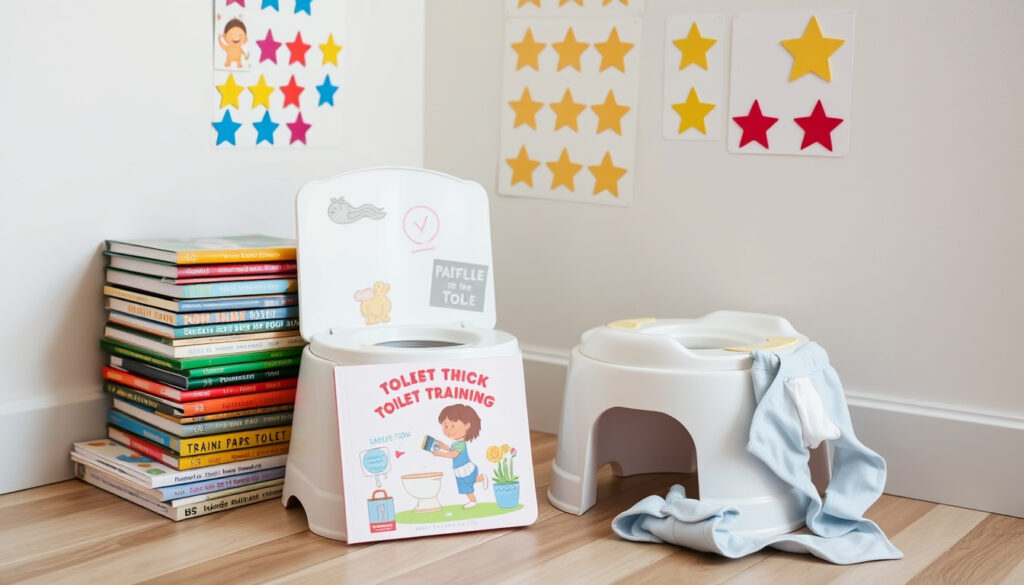
What Does Potty Trained Mean? Age, Methods, and Red Flags
The moment your toddler tugs at a wet diaper or hides behind the curtain when they need to go marks the start of potty training — a milestone that looks different for every family than rigid age charts suggest. This guide looks at what “potty trained” actually means today, when most children reach this goal, which methods work, and what warning signs deserve your pediatrician’s attention.
Average age of completion: 36 months ·
Children potty trained by 3 years old: Approximately 75-80% ·
Age to start readiness signs: 18-24 months ·
Nighttime dryness achieved: Later, often by age 5-7 ·
Method using infant elimination communication: Starts from birth
Quick snapshot
- The process of learning to use the toilet independently (American Academy of Pediatrics, the nation’s leading children’s health authority).
- Also called toilet learning or toilet training (Wikipedia).
- Child-led versus parent-led approaches exist. (American Academy of Pediatrics, the nation’s leading children’s health authority)
- Look for readiness signs between 18 and 24 months (Mayo Clinic Press, a trusted medical publication).
- Most children complete day training by 36 months. (Mayo Clinic Press, a trusted medical publication)
- Night training often happens much later (age 5-7). (Mayo Clinic Press, a trusted medical publication)
- Traditional: parent-directed scheduled sits (AAP).
- Child-led: follow child’s cues (toilet learning) (ERIC, the UK children’s bowel and bladder charity).
- Elimination communication: start from infancy using timing and signals. (AAP)
- Daytime independence by age 3 for most children (UC Davis Health, a leading academic medical center).
- Slight gender differences: girls train 2-3 months earlier. (UC Davis Health, a leading academic medical center)
- Nighttime dryness is a separate milestone achieved later (Care.com, a parenting resource).
Five facts that define the landscape of American toilet training today:
| Fact | Value |
|---|---|
| Day training completion | By 36 months for most children (UC Davis Health) |
| Readiness signs appear | Typically at 18-24 months (Mayo Clinic Press) |
| Boys vs girls average age | Girls: ~30-36 months; Boys: ~33-39 months (Care.com) |
| Nighttime dryness | Often achieved by age 5-7 (Mayo Clinic, a nonprofit academic medical center) |
| Alternative term | Toilet learning (ERIC, the UK children’s bowel and bladder charity) |
What Does It Mean to Be Potty Trained?
Key components of toilet learning
- Being potty trained means being able to recognize the urge to urinate or have a bowel movement, get to the toilet, undress, eliminate, and dress again with minimal help (American Academy of Pediatrics, the leading U.S. children’s health authority).
- The ERIC charity (the UK’s only children’s bowel and bladder charity) describes the process as “helping a child use the potty as part of their overall learning,” not as a one-time event.
- Modern experts increasingly use the phrase “toilet learning” to emphasize that this is a skill the child acquires, not a schedule the parent enforces (Wikipedia).
The move from “potty training” to “toilet learning” changes who is the active participant. In the traditional model, the parent trains; in toilet learning, the child learns. That distinction explains why many one-size-fits-all methods fail for kids who aren’t developmentally ready.
Differences between day and night training
- Daytime control typically arrives first because the bladder muscle and the child’s awareness of its signals mature together around age 3 (Mayo Clinic, a U.S. nonprofit academic medical center).
- Nighttime dryness is a separate milestone. The body must produce a hormone that slows urine production during sleep — this isn’t something a child can learn or practice. The Care.com parenting resource notes nighttime dryness often isn’t achieved until age 5 to 7.
- Nocturnal enuresis (bedwetting) is considered typical up to age 7 and only becomes a medical concern beyond that point (UC Davis Health).
The implication: a child who is completely dry during the day but still wets at night is not behind schedule. The two skills are neurologically and hormonally distinct.
At What Age Are Most Children Potty Trained?
Average age ranges for boys and girls
- UC Davis Health (a leading California academic medical center) reports most children complete daytime training by 36 months.
- Girls tend to reach this milestone earlier. Care.com found girls typically train 2-3 months ahead of boys, finishing around 30-36 months compared to 33-39 months for boys.
- Boys Town National Research Hospital emphasizes age is not a sufficient criterion: the child must show steady developmental readiness, regardless of the calendar.
Sex differences in potty training completion are real but modest — two to three months. They reflect differences in physical maturation and social expectations, not capacity. The “harder to train” perception often masks a deeper variable: boys typically sit down to start and then transition to standing later, adding a step not required for girls.
The 3-year-old benchmark and its accuracy
- Approximately 75-80% of 3-year-olds in the U.S. are fully day-trained (UC Davis Health). That leaves one in five children still working on daytime control at age 3 — well within the normal range.
- The AAP (American Academy of Pediatrics, the country’s top pediatric authority) states most children are physiologically ready around 18 months but cognitively ready only after their second birthday.
- The Raising Children Network (Australian parenting resource) describes typical readiness as “about 2 years on” rather than a strict age cutoff, echoing global consensus that developmental signs matter more than birthday candles.
What this means: the parent who feels pressure because their 3-year-old isn’t trained is wrestling with a statistical average, not a medical deadline. The data says 20-25% of 3-year-olds are still in diapers during the day — that is not a red flag.
What Are the Do’s and Don’ts of Potty Training?
The UC Davis Health approach
- Do take your child to the potty every 30 to 60 minutes initially, especially after meals and before bed (UC Davis Health).
- Don’t punish or scold for accidents. The AAP guidance says the process should feel natural and low-stakes, not like a test.
- Do look for developmental readiness: staying dry for at least 2 hours, showing interest in underwear, being able to pull pants up and down, and following simple instructions (Mayo Clinic).
- Do use encouragement and small rewards (stickers, praise) but avoid candy-based systems that create an expectation of treats for bodily functions (Berkshire Healthcare NHS Foundation Trust).
Common mistakes that delay progress
- Starting too early. If a child cannot stay dry for two hours, cannot communicate the need, or fights the potty physically, wait one to three months and try again (Boys Town National Research Hospital).
- Expecting nighttime control too soon. Nighttime dryness is physiologically driven, not trained. Pushing a child who isn’t ready creates shame without results (Care.com).
- Inconsistency across caregivers. If daycare uses one approach and parents use another, the child receives mixed signals. Agreement on vocabulary, timing, and rewards helps (Johns Hopkins Medicine).
- Using pull-ups like diapers. Pull-ups can be useful tools, but if they are treated as just another absorbent diaper, the child doesn’t feel the wetness that motivates toilet use (Lewisham and Greenwich NHS guidance).
What Is Potty Training Called Now and How Does Elimination Communication Work?
Toilet learning as a modern philosophy
- Wikipedia lists “toilet training, potty training, or toilet learning” as interchangeable terms, but the philosophy behind them differs. Toilet learning puts the child in the driver’s seat.
- ERIC, the UK children’s bowel and bladder charity, supports child-led potty learning. Their guidance emphasizes that forcing a child to sit on a potty before they are ready can cause resistance and prolong the process.
- The shift in language reflects a broader pediatric consensus: teaching children to listen to their own bodies works better than imposing adult schedules (AAP).
Infant potty training and elimination communication basics
- Elimination communication (EC) involves parents observing infant cues (squirming, facial expressions, timing after feeding) to offer the potty from birth, rather than waiting until toddlerhood (Wikipedia).
- Proponents claim EC can lead to earlier day and night training, but Blueberry Pediatrics (pediatric telehealth platform) notes the approach lacks large-scale clinical trials to confirm superiority over readiness-based methods.
- Regardless of the label, Johns Hopkins Medicine advises that the core principle — responding to the child’s signals — works across all philosophies.
Elimination communication requires a parent who can dedicate sustained observation time. For a working parent or a family with multiple young children, the model of watching for every subtle grunt from birth is often impractical — and that is okay. Effectiveness is about fit, not philosophy.
Which Gender Is Harder to Potty Train?
Statistical differences in readiness ages
- Care.com references that girls complete training 2-3 months earlier on average, finishing around 30-36 months compared to 33-39 months for boys.
- The AAP does not officially endorse a gender gap in readiness, but acknowledges that language development (which girls tend to develop earlier) helps with communicating the need to use the toilet.
Why boys may be perceived as harder
- Boys typically start potty training sitting down (for bowel movements) and then need to transition to standing for urination — a two-step process girls don’t face (Boys Town National Research Hospital).
- Social expectations may play a role. Parents often train girls earlier because of perception, creating a self-fulfilling prophecy. When researchers control for parental timing, the gap narrows (Care.com).
A boy who is 33 months old and not yet trained is not behind a girl of the same age who is trained — the average gap means each child follows their own timeline. The perception that boys are “harder” leads parents to start later and expect less, which can become a self-reinforcing cycle.
What Are the Red Flags for Potty Training?
Medical and developmental warning signs
- No interest by age 4. If a child shows no curiosity about using the toilet by their fourth birthday, Boys Town National Research Hospital recommends a pediatric evaluation.
- Pain with bowel movements. Children who cry, scream, or hold stool for three or more days may be constipated. The AAP says constipation is the most common cause of potty training regression.
- Inability to stay dry for 2 hours by age 3. The ability to remain dry for a two-hour window is a reliable indicator that bladder muscles are ready. If that milestone has not appeared, readiness is not there (Mayo Clinic Press).
When to consult a pediatrician
- Constipation that doesn’t resolve with dietary changes (fiber, hydration) within two weeks. Johns Hopkins Medicine notes that chronic constipation can cause overflow incontinence that looks like “accidents.”
- If a child who was trained for six months or longer suddenly starts having frequent accidents. This regression can signal stress, illness, or developmental shifts (new sibling, starting school) and needs professional evaluation (Mayo Clinic).
- Reduced urine output or painful urination — these are signs of a possible urinary tract infection, which requires medical treatment, not training adjustment (Lewisham and Greenwich NHS Trust).
- If a child over age 7 is still wetting the bed regularly, a primary care visit can rule out diabetes, sleep disorders, or structural bladder issues (UC Davis Health).
The most overlooked red flag is not the child’s failure to train — it’s the parent’s feeling that the process has become a daily battle. When a parent is frustrated, the child feels pressure, and resistance hardens. That emotional stalemate is often fixable with a one- to three-month break, not with more intense training.
“Take your child to the potty every 30 to 60 minutes initially, especially after meals and before bed. Do not punish for accidents.”
UC Davis Health (academic medical center potty training guidance)
“Toilet learning means helping a child use the potty as part of their overall learning, not as a fixed schedule.”
ERIC, The Children’s Bowel and Bladder Charity (UK)
“Most children are physiologically ready around 18 months, but cognitively ready only sometime after their second birthday.”
American Academy of Pediatrics
Becoming potty trained is not a pass-fail test administered at 36 months. The data shows four out of five children reach daytime independence by that age, but the remaining fifth are not delayed — they are on a different developmental arc. Nighttime dryness, elimination communication from infancy, the debate over toilet learning versus traditional training — each represents a choice families make based on their child’s actual signals, not a calendar or a neighbor’s story. For parents in the United States (where pediatric guidance from sources like the AAP and UC Davis Health sets the standard), the choice is clear: watch for readiness, follow the child’s lead on the timeline, and resist the pressure to meet an arbitrary age. Give the process the grace it needs, and the child will get there.
healthychildren.org, nationaldiaperbanknetwork.org, texasdiaperbank.org, healthline.com, presselogik.de
For a deeper look at when to start and what warning signs to watch for, see this guide on potty training readiness and red flags.
Frequently asked questions
Can you start potty training before age 1?
Yes, with elimination communication, some parents begin offering the potty from birth. However, the AAP notes that true independent control of bladder and bowel muscles typically only becomes possible after 18 months.
Is constipation a common problem during potty training?
Yes. Johns Hopkins Medicine says constipation is the most frequent medical issue that interferes with potty training, often masked as resistance or accidents.
How do I know if my child is ready for potty training?
Mayo Clinic Press and the AAP list staying dry for two hours, pulling clothes up/down, showing interest in the toilet, following simple instructions, and communicating about wet/dirty diapers.
Should I punish my child for potty accidents?
No. UC Davis Health and the AAP explicitly recommend against punishment — it creates shame and increases resistance.
What is the best potty training method for a strong-willed child?
ERIC (UK children’s bowel and bladder charity) suggests a child-led approach: wait, hand over control, and make the potty available without pressure. A break of one to three months often resets the dynamic.
How long does it typically take to potty train a child?
For most children, the process takes three to six months from first attempt to daytime independence. Boys Town National Research Hospital notes that earlier starts (18 months) tend to take longer than later starts (24-30 months).
Related reading: Potty Training Readiness: Do’s and Don’ts by Age & Signs
More related posts
 Mehdi Hasan: Career, Cancellation & Zeteo Launch
 DNA Tests in Ireland: Costs, Accuracy & Best Kits
 Mickey Mouse: History, Friends, Cartoons, and How to Draw
 How Much Is Amazon Prime in 2025? Cost, Discounts & Value
 John Denver: Complete Facts, Cause of Death, and FAQs
 Andy Coulson: from News of the World editor to crisis consultant
 Roksana Lecka: Sentencing, Deportation, and Latest News
 Ice Cube: Net Worth, Controversies, and Current Life (2024)
