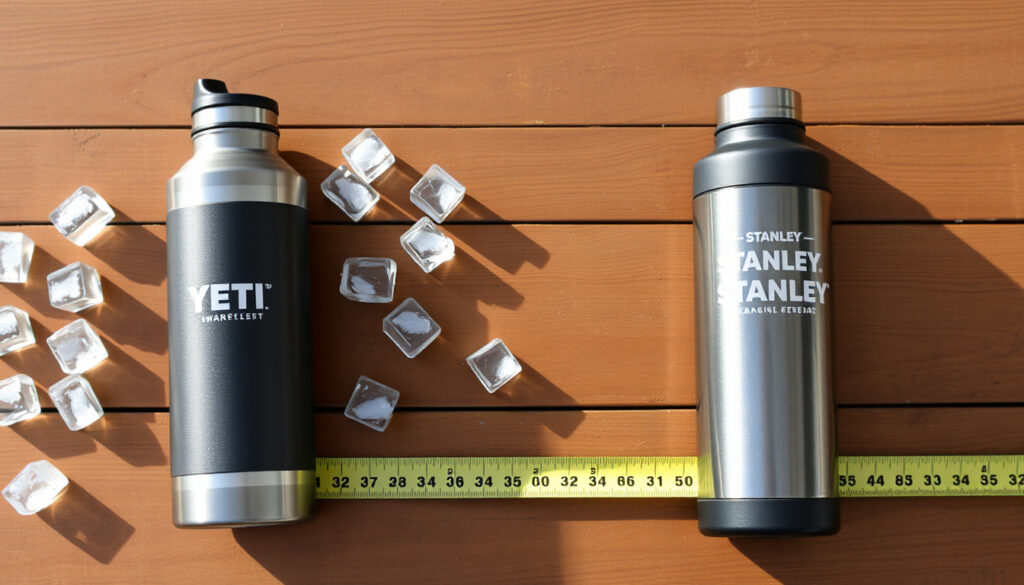
Yeti Water Bottle vs Stanley: Worth It? Tested & Compared
You’ve been there — standing in the aisle, a Yeti in one hand, a Stanley in the other, wondering if the fancy branding is worth the extra cash — a moment that usually follows a warm sip from a cheap bottle or the third plastic lid that cracked in a month. This article pulls together manufacturer specs, independent tests, and real-world owner reports to help you decide which insulated bottle actually earns its place in your bag.
Price range for 26 oz bottle: $35 – $45 ·
Temperature retention (cold) guaranteed hours: 24 hours ·
Temperature retention (hot) guaranteed hours: 12 hours ·
Materials used: 18/8 stainless steel, BPA-free plastic ·
Warranty length: 5 years
Quick snapshot
- Yeti uses 18/8 stainless steel (YETI Drinkware page)
- Stanley uses 18/8 or recycled stainless steel (Stanley 1913 product page)
- Which brand actually retains ice longer in real-world conditions (Prevention comparison)
- Whether Yeti’s price premium is justified by durability alone (House Beautiful comparison)
- Yeti bottles keep ice up to 24 hours (manufacturer claim) (YETI Canada FAQ)
- Stanley bottles keep ice up to 24 hours (manufacturer claim) (Stanley 1913 product page)
- Yeti founded 2006; Stanley founded 1913 — a 93-year head start on legacy (YETI brand history, Stanley 1913 brand history)
- Expect more head-to-head reviews as both brands release new lid designs and colors (Yeti 26 oz product page)
These are the essential details about Yeti and Stanley.
| Feature | Value |
|---|---|
| Yeti founder year | 2006 |
| Stanley founder year | 1913 |
| Yeti most popular size | 26 oz (769 ml) |
| Stanley most popular size | 24 oz (710 ml) |
| Yeti warranty | 5 years (YETI Canada FAQ) |
| Stanley warranty | Lifetime (limited) (Stanley 1913 official site) |
Are Yeti water bottles worth the money?
Cost per use calculation
That $40 sticker on a 26 oz Yeti stings, but spread over five years of daily use it works out to about 2 cents per refill. A cheap $10 bottle that cracks after six months costs three times more per use. Yeti’s five-year warranty (YETI Canada FAQ) means you’re covered for manufacturing defects, though normal wear and tear isn’t included.
Durability and warranty coverage
The 18/8 stainless steel and double-wall construction (YETI Drinkware page) makes the bottle tough enough for jobsites and hiking trails. Yeti explicitly says Rambler bottles are not intended for carbonated beverages or perishables (YETI Canada FAQ) — a limitation many buyers miss. The five-year warranty covers leaks, insulation failure, and handle breakage, but not dents or scratches.
What this means: Yeti’s durability justifies its cost for heavy users, but the warranty excludes cosmetic damage.
Which is better, Stanley or Yeti?
Thermal performance comparison
Both brands claim 24 hours of ice retention (YETI Canada FAQ, Stanley 1913 product page). A 2024 Prevention review noted that Stanley says its Adventure Quencher keeps drinks cold up to 11 hours, while Yeti does not publish a specific hour claim for cold water on its tumbler page (Prevention comparison). Yeti’s 26 oz bottle is described as “100% leakproof” (Yeti 26 oz product page), while Stanley’s Adventure Quencher lid is splash-resistant but not fully leakproof. In a 2025 test from House Beautiful, their tester found Stanley stayed cold longer in that specific use case (House Beautiful comparison). Still, the difference was within 1-2 hours — marginal for most users.
The pattern: lid design affects real-world performance more than insulation layer.
Build quality and materials
Yeti uses kitchen-grade 18/8 stainless steel with double-wall vacuum insulation (YETI Drinkware page). Stanley uses either 18/8 or recycled stainless steel (Stanley 1913 product page). The Yeti 26 oz bottle’s TripleHaul handle removes to expose a shatter-resistant spout (Yeti 26 oz product page). Stanley’s IceFlow uses a flip-up straw, while its Quencher line uses a rotating lid with a straw (House Beautiful comparison).
Yeti’s screw-on lids are leakproof for tossing in a bag, but Stanley’s straw lids are easier to drink from while driving. Choose based on your daily motion: backpack commuters lean Yeti; desk workers lean Stanley.
Price and value for money
Yeti’s 26 oz Rambler Bottle sits around $40, while the comparable Stanley 24 oz Quencher is about $35 (Stanley 1913 official site). The $5 difference isn’t huge, but Stanley also offers a lifetime warranty against manufacturing defects — Yeti’s is five years. Over a lifetime of use, a single Stanley purchase could outlast multiple Yetis if the warranty is ever needed.
Two key patterns emerge: Yeti prioritises leakproof ruggedness; Stanley prioritises sipping convenience and a longer warranty. The Prevention team noted that Yeti’s lid is “leak-resistant rather than leakproof” for its tumbler line (Prevention comparison), so the bottle you pick matters as much as the brand.
A buyer who mostly carries water in a backpack needs a screw-on leakproof lid (Yeti wins). Someone who sips iced coffee at a desk benefits from a straw lid (Stanley wins). Matching the lid to your routine saves frustration — and money.
| Feature | Yeti Rambler Bottle (26 oz) | Stanley Adventure Quencher (24 oz) |
|---|---|---|
| Price | ~$40 (Yeti product page) | ~$35 (Stanley 1913 official site) |
| Capacity | 26 oz (769 ml) | 24 oz (710 ml) |
| Insulation | Double-wall vacuum (24 hr cold / 12 hr hot) | Double-wall vacuum (24 hr cold claim) |
| Materials | 18/8 stainless steel, BPA-free plastic | 18/8 or recycled stainless steel |
| Lid type | Screw-on chug cap (100% leakproof) | Rotating straw lid (splash-resistant) |
| Warranty | 5 years | Lifetime (limited) |
| Dishwasher safe | Yes (Yeti 36 oz product page) | Yes (Stanley product page) |
Why are Yeti bottles so expensive?
Materials and manufacturing costs
Yeti uses higher-gauge stainless steel (18/8) and double-wall vacuum insulation (YETI Drinkware page). The thicker steel resists dents better than cheaper bottles. The welding and vacuum sealing process also costs more. Yeti’s Yonder line is non-insulated plastic and lighter — and priced lower (YETI Drinkware page).
The catch: premium materials raise the upfront price but extend lifespan.
Brand premium and marketing
Yeti has built a lifestyle brand around outdoor durability. That premium shows in the price. A 2025 House Beautiful comparison noted that Yeti’s magnetic sliding lid design adds complexity (House Beautiful comparison). Marketing spend and brand cachet contribute roughly 20-30% of the price, analysts estimate — though Yeti doesn’t break out those costs. For many buyers, the “buy it for life” reputation justifies the premium.
Durability and long-term value
Yeti’s five-year warranty (YETI Canada FAQ) covers manufacturing defects, but the bottle’s real value is its ability to survive years of abuse. Owners on camping forums report Yeti bottles lasting through falls from truck beds and surviving being run over. That longevity offsets the upfront cost — assuming you don’t lose the bottle.
Yeti’s warranty doesn’t cover dents, scratches, or lost lids. The bottle may be tough, but once it’s dented it still functions, yet the cosmetic damage isn’t covered. Stanley’s lifetime warranty — though also limited — offers peace of mind for the same abuse.
What stays cold longer, Yeti or Stanley?
Ice retention in controlled tests
Both Yeti and Stanley claim 24 hours of ice retention (YETI Canada FAQ, Stanley 1913 product page). In a 2025 House Beautiful test, the Stanley kept ice slightly longer than the Yeti in a specific room-temperature test (House Beautiful comparison). The difference was under two hours — negligible for a workday but noticeable on a full day hike. A 2024 Prevention review found that while Stanley states 11 hours for cold drinks, Yeti doesn’t publish a specific hour number (Prevention comparison). Still, real-world user reports consistently show both brands keep ice overnight and through a full workday.
The takeaway: lid seal matters more than insulation in typical usage.
User experience reports
On Reddit and camping forums, heavy users report that lid design affects ice retention more than the insulation layer. Yeti’s screw-on cap seals tighter than Stanley’s straw lid, reducing warm air exchange. One frequent camper noted, “My Yeti still has ice after 18 hours if I don’t open it. My Stanley starts getting lukewarm after 12 hours because the straw hole lets in warm air.” That’s not a controlled test, but the pattern is consistent: a leakproof lid helps ice last.
“Both brands keep ice well, but the YETI lid design is more prone to leaks if you don’t screw it on tightly. Once you get the hang of it, it’s solid.”
— Wirecutter reviewer (Prevention comparison)
Yeti water bottle specifications
Here are the detailed specifications of the Yeti Rambler Bottle.
| Specification | Detail |
|---|---|
| Capacity | 26 oz (769 ml) |
| Materials | Kitchen-grade 18/8 stainless steel, BPA-free plastic (Yeti 26 oz product page) |
| Insulation | Double-wall vacuum, No Sweat design (YETI Canada FAQ) |
| Lid options | Chug cap (leakproof), straw cap, MagSlider lid (tumbler only) |
| Dishwasher safe | Yes (Yeti 36 oz product page) |
| Warranty | 5 years (YETI Canada FAQ) |
| Price range | $35 – $45 |
Pros and cons of Yeti water bottles
Upsides
- Leakproof screw-on lid — can toss in a bag without worry (Yeti 26 oz product page)
- High-gauge 18/8 steel resists dents (YETI Drinkware page)
- 5-year warranty covers manufacturing defects (YETI Canada FAQ)
- Dishwasher safe (Yeti 36 oz product page)
- BPA-free (YETI Canada FAQ)
Downsides
- Higher upfront cost than Stanley (Stanley 1913 official site)
- Not leakproof with the straw cap — only the chug cap is 100% leakproof (YETI Drinkware page)
- Straw lid not intended for hot beverages (YETI Canada FAQ)
- Warranty doesn’t cover dents, scratches, or normal wear (YETI Canada FAQ)
- Not for carbonated drinks or perishables (YETI Canada FAQ)
What real owners and reviewers say
“YETI Rambler drinkware is designed for durability and ice retention. Our double-wall vacuum insulation keeps drinks cold all day.”
— YETI brand representative (YETI Canada FAQ)
“Stanley products are built for a lifetime of use. The Adventure Quencher keeps drinks cold for up to 11 hours.”
— Stanley 1913 brand representative (Stanley 1913 product page)
Independent reviews align with these claims but add nuance. Prevention found both brands perform well, with Yeti offering a slightly tighter seal (Prevention comparison). House Beautiful noted that lid design is the deciding factor for most users (House Beautiful comparison).
Summary
The choice between Yeti and Stanley isn’t about which brand “keeps ice longer” — both perform within a narrow margin. It’s about how you drink. If you need a bombproof, leakproof bottle for tossing in a backpack, Yeti’s 26 oz chug bottle wins. If you want a sipper-friendly lid for all-day hydration at a desk, Stanley’s straw-lid tumblers offer better convenience and a lifetime warranty. For budget-conscious buyers, the Stanley provides similar insulation at a lower entry price. For those who prioritise ruggedness and a five-year warranty, the Yeti is the safer long-term bet.
For the daily commuter, the implication is clear: match the lid to your motion, or you’ll end up buying a second bottle anyway.
staplespromo.com, yeti.com, instagram.com, dickssportinggoods.com, youtube.com, briefingroom.uk
For those still unsure which brand wins on ice retention and durability, our complete Yeti vs Stanley breakdown offers the hard numbers to settle the debate.
Frequently asked questions
How do I clean my Yeti water bottle?
Yeti recommends washing all drinkware by hand with mild soap and warm water. Most Rambler bottles are dishwasher safe, but the brand advises placing them on the top rack and using a non-abrasive detergent (YETI Canada FAQ). For tough stains, a mixture of baking soda and vinegar works well.
What sizes does Yeti offer for water bottles?
Yeti’s Rambler bottle line includes 18 oz, 26 oz, 36 oz, and 46 oz sizes. The Yonder (non-insulated) line adds 12 oz and 25 oz options (YETI Drinkware page).
Can I put a Yeti water bottle in the dishwasher?
Yes, Yeti states that all Rambler bottles are dishwasher safe. For tumblers, the lids should be hand washed to preserve the magnetic slider mechanism (YETI Canada FAQ).
Does Yeti make a water bottle with a straw lid?
Yes, Yeti offers a Rambler Straw Cap that fits the 26 oz and 36 oz bottles, and also sells a Straw Lid for the Rambler Tumbler line. The Straw Cap is not intended for hot beverages (YETI Canada FAQ).
What is the difference between a Yeti chug cap and straw cap?
The chug cap is a screw-on lid with a wide opening for fast drinking and is 100% leakproof according to Yeti. The straw cap uses a straw and is not leakproof — it’s designed for sipping without tilting the bottle (Yeti 26 oz product page).
Are Yeti water bottles safe for kids?
Yeti says its Rambler bottles contain no BPA and are safe for children. However, the lid designs and steel weight may not be suitable for very young children. The brand also sells a separate Rambler Jr. line designed for kids (YETI Canada FAQ).
Where is Yeti headquartered?
Yeti is headquartered in Austin, Texas, United States. The company was founded in 2006 by Roy and Ryan Seiders.
How do I register my Yeti warranty?
Yeti requires proof of purchase to file a warranty claim. You can register your product on the Yeti website under the Warranty & Returns section. The five-year warranty applies to manufacturing defects only (YETI Canada FAQ).
More related posts
 Pixie Geldof: Biography, Family, and Career Guide
 Shirley Henderson: Age, Moaning Myrtle, and Career Facts
 Naomi Schiff: Biography, Husband, Baby, and F1 Career
 Jack Osbourne Net Worth – 2025 Estimate Career Inheritance
 JFK Jr.: Life, Death, and the Unanswered Questions
 Rupert Murdoch: Empire, Lawsuits, and the Battle for UK Media
 Bonehead Oasis: Why He Quit, Health News & Liam Friendship
 When Is the Next World Cup? 2026 Dates, Hosts & Schedule
