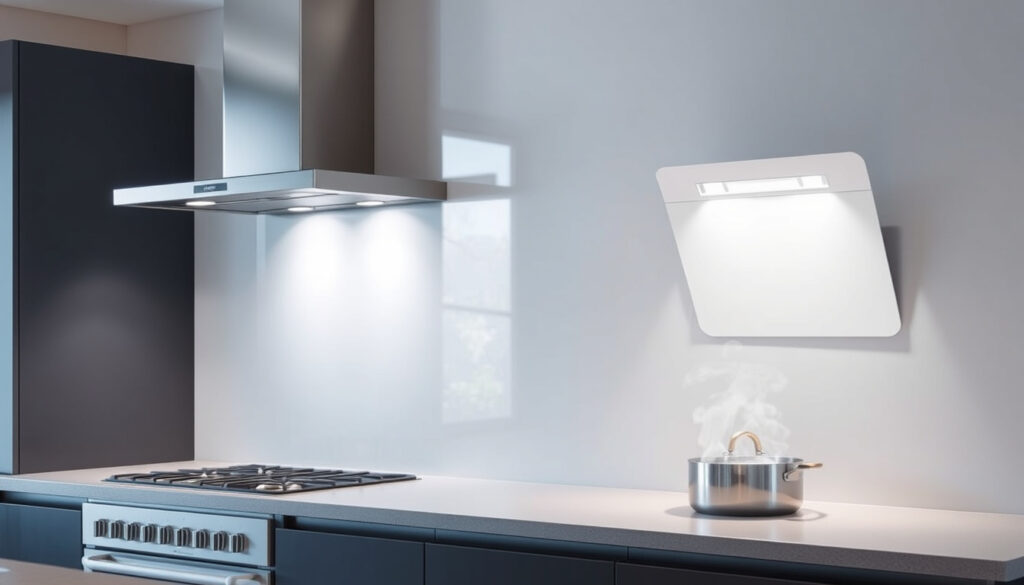
Cooker Hood vs Extractor Fan: Which Is Better for Your Kitchen
Few kitchen upgrades spark as much confusion as choosing between a cooker hood and an extractor fan. In Ireland, the terms are used almost interchangeably, but the real decision comes down to whether your kitchen can vent outside or not. This guide cuts through the marketing, compares the options, and lays out what you can expect to pay to get one installed.
Installation cost (plug-in): €100–€250 (DID Electrical (Irish appliance retailer)) ·
Installation cost (ducted, new vent): from €250 (TaskMatch (Irish installation marketplace)) ·
Most common type sold in Ireland: chimney / wall-mounted, 60 cm width (NEFF Ireland) ·
Delivery cost (Ireland): from €29.99 (DID Electrical) ·
UK installation benchmark: £250–£350 (Checkatrade (UK tradesman platform))
Quick snapshot
- Cooker hood and extractor fan are interchangeable terms in Ireland (DID Electrical (Irish appliance retailer))
- Bosch, NEFF, and Faber are leading brands in the Irish market (NEFF Ireland (appliance manufacturer))
- Ducted models require external venting; recirculating models use carbon filters (TaskMatch (Irish installation marketplace))
- Exact market share between ducted and recirculating models in Ireland
- Which specific model is “best” – it depends on kitchen layout and personal preference
- Installation cost benchmarks have remained stable (€250–€350) based on 2025–2026 quotes from Irish and UK installers (TaskMatch (Irish installation marketplace), Checkatrade (UK tradesman platform))
- Check your kitchen for an external vent. If none exists, consider a recirculating model with charcoal filters. If you have an external wall, a ducted hood is more effective.
A few key numbers and one pattern: installation costs vary significantly depending on whether you need ducting or not.
| Label | Value |
|---|---|
| Installation cost (basic) | €100–€250 (DID Electrical (Irish appliance retailer)) |
| Installation cost (ducted, new vent) | from €250 (TaskMatch (Irish installation marketplace)) |
| Types available | wall-mounted, integrated, ceiling (NEFF Ireland (appliance manufacturer)) |
| Delivery cost (Ireland) | from €29.99 (DID Electrical (Irish appliance retailer)) |
| UK installation benchmark | £250–£350 (Checkatrade (UK tradesman platform)) |
| Second-hand price (Ireland) | from €230 (Adverts.ie (Irish classifieds)) |
| Retrofitting vs new ductwork (US benchmark) | $200–$850+ base, $1,200–$2,500+ new ductwork (Gerhard’s Appliance (US specialist)) |
Which is better, a cooker hood or extractor fan?
Key differences in design
- Cooker hoods are typically wall-mounted or chimney-style units; extractor fans are often ceiling-mounted or inline units. Both do the same job: remove grease and steam.
- The term “cooker hood” is standard in Ireland and the UK; “extractor fan” is a broader category that includes ceiling-mounted and inline models. Many retailers list both under “cooker hoods” (DID Electrical (Irish appliance retailer)).
- Performance depends more on ducting than on the label: ducted models vent outside, recirculating models filter and return air (YouTube product guide).
When to choose a cooker hood
- If you have wall space above your hob.
- If you want a visible appliance that matches your kitchen design.
- If you can install ducting to the outside.
When to choose an extractor fan
- If your kitchen has no wall above the hob (e.g., island or peninsula).
- If you want a discreet, low-profile unit.
- If you are installing in a flat or rented property where ducting is not allowed.
The implication: the choice is less about brand and more about your kitchen layout. Ducted models outperform recirculating ones, so if you can vent outside, that’s the better option regardless of the name on the box.
What is the difference between a cooker hood and an extractor fan?
Terminology overlap
In Irish retail, the terms are used interchangeably. DID Electrical sells both “cooker hoods” and “fans” in the same category (DID Electrical (Irish appliance retailer)). NEFF Ireland markets its range under “extractor hoods” (NEFF Ireland (appliance manufacturer)). There is no technical boundary – an extractor fan is simply a sub-type of cooker hood.
Installation requirements
- Cooker hoods are usually wall-mounted; extractor fans are often ceiling-mounted or inline.
- Both can be ducted or recirculating. Ducted installations need a route to the outside; recirculating models only need a power source (TaskMatch (Irish installation marketplace)).
Suction power differences
Suction power is measured in cubic metres per hour (m³/h). A standard kitchen typically needs a unit with at least 400 m³/h. However, the difference between a “cooker hood” and an “extractor fan” with the same airflow rating is zero – the performance is identical. The key variable is whether the air is expelled outside or recirculated.
Noise levels
Noise levels vary by model, not by category. Ceiling-mounted extractor fans tend to be quieter because the motor is farther from the user, but modern cooker hoods also offer silent modes. Check the decibel rating (dB) – look for 65 dB or below for open-plan kitchens.
What this means: don’t get stuck on the name. Compare ducting capability, airflow, and noise – those are what matter.
Do all cooker hoods need to be vented outside?
Ducted hoods
- These expel air directly outside through ducting. They are the most effective at removing moisture, grease, and odours.
- Installation involves drilling through an external wall or routing ductwork – a job that adds cost (TaskMatch (Irish installation marketplace)).
Recirculating hoods
- These draw air through charcoal filters and release it back into the kitchen. They do not require an external vent.
- Charcoal filters must be replaced every 3–6 months to maintain performance (YouTube product guide).
Hybrid models
Some hoods can be installed either way: ducted if you have access to outside, or recirculating if not. These offer flexibility, especially for renters who may move later.
Building regulations in Ireland
There is no general requirement to have a ducted hood. However, many apartments and leasehold properties prohibit drilling through external walls, making recirculating the only realistic option. Always check your lease before planning installation.
The catch: if you can duct outside, do it. Recirculating is a compromise for kitchens that cannot vent externally.
Do you need an electrician to fit a cooker hood?
Hardwired vs plug-in
- Most built-in cooker hoods are hardwired and require connection to a fused spur by a qualified electrician.
- Plug-in hoods exist but are less common in Ireland. They are typically freestanding or low-cost models.
When an electrician is mandatory
- In Ireland, any hardwired electrical work must be carried out by a registered electrician (Safe Electric). This includes connecting the hood to the mains.
- If you are replacing an existing hardwired hood, the wiring is already in place, but the final connection still needs a professional (TaskMatch (Irish installation marketplace)).
DIY feasibility
Recirculating plug-in models can be installed by a confident DIYer – they just need a power socket and mounting on a wall. For ducted installations, the drilling and ductwork are usually best left to a handyman or builder, with the electrician called in for the final connection.
Part P regulations in UK/Ireland
Part P of the Building Regulations applies in England and Wales, while Safe Electric governs in Ireland. Both require that electrical installations in kitchens are carried out by competent persons. Always hire a certified electrician for hardwired work.
The trade-off: plug-in hoods save on electrician fees (€100–€250), but your choice of model is limited. Hardwired hoods are more common and offer more design options.
What is the best cooker hood to buy?
Top brands: Bosch, Neff, Faber
- Bosch and NEFF dominate the Irish market because of their presence in major retailers (NEFF Ireland (appliance manufacturer)).
- Faber is a speciality brand often sold through independent kitchen studios.
- No single brand is “best” – the right model depends on your kitchen layout and budget.
Key specs to check
- Airflow: at least 400 m³/h for a standard kitchen.
- Noise: 65 dB or lower for open-plan living.
- Filter type: grease mesh (dryer) and charcoal (for recirculating models).
Buyer checklist
- Measure your hob width – 60 cm is standard, but 90 cm is better for larger hobs.
- Decide on ducted vs recirculating based on your kitchen’s ability to vent outside.
- Check whether the model is plug-in or hardwired – this affects installation cost.
- Factor in filter replacement costs (charcoal filters every 3–6 months).
Upsides
- Wide range of designs and brands
- Ducted models remove grease and moisture effectively
- Can be installed in most kitchens with proper planning
Downsides
- Hardwired installation requires electrician, adding cost
- Recirculating models are less effective and require filter replacements
- Large hoods (90 cm) can be expensive
Why this matters: the “best” cooker hood is not a single product – it is the one that fits your kitchen’s ducting ability, your budget, and your design taste. Do not overpay for brand prestige if a simpler model with the same airflow will do.
Two options, one trade-off: ducted hoods are more effective but cost more to install; recirculating hoods are cheaper to install but less effective and require ongoing filter costs.
| Aspect | Ducted | Recirculating |
|---|---|---|
| Effectiveness | Removes air outside – best for moisture and grease | Filters air and returns it – less effective |
| Installation complexity | Requires wall penetration and ductwork | Simple – no vent needed |
| Installation cost | from €250 (TaskMatch (Irish installation marketplace)) | €100–€250 (DID Electrical (Irish appliance retailer)) |
| Ongoing costs | Minimal – filters cleaned yearly | Charcoal filters every 3–6 months |
A dozen specifications, drawn from Irish and UK sources, draw a consistent picture: installation cost is the biggest variable.
| Specification | Value |
|---|---|
| Width (common) | 60 cm (DID Electrical (Irish appliance retailer)) |
| Installation cost (plug-in) | €100–€250 (DID Electrical (Irish appliance retailer)) |
| Installation cost (ducted) | from €250 (TaskMatch (Irish installation marketplace)) |
| Ducting installation time | up to 4 hours (Angi (US home services site)) |
| Labour rate (US) | $85 per hour (Angi (US home services site)) |
| UK installation benchmark | £250–£350 (Checkatrade (UK tradesman platform)) |
| UK average new installation | £250 (MyJobQuote (UK tradesman platform)) |
| Delivery cost (Ireland) | from €29.99 (DID Electrical (Irish appliance retailer)) |
| Second-hand price (Ireland) | from €230 (Adverts.ie (Irish classifieds)) |
| Types available | wall-mounted, integrated, ceiling (NEFF Ireland (appliance manufacturer)) |
Upsides
- Ducted models effectively remove grease and moisture
- Wide range of designs and price points
- Recirculating models are easy to install without major building work
Downsides
- Hardwired installation requires an electrician, adding €100–€250
- Recirculating models are less effective and require filter replacements
- Ducted installation can be impossible in some properties
Confirmed facts
- Cooker hood and extractor fan are interchangeable terms in Ireland.
- Ducted models require external venting; recirculating models use charcoal filters.
- Installation cost ranges from €100 (plug-in) to €350+ (ducted).
- Bosch, NEFF, and Faber are leading brands in the Irish market.
What’s unclear
- Exact market share of ducted vs recirculating models.
- Which specific model is “best” – it depends on kitchen layout and budget.
“We offer installation from €99.99 on selected cooker hoods.”
DID Electrical (Irish appliance retailer)
“New extractor fan installations generally start from around €250 because extra work may include drilling a vent through a concrete wall and adding venting ducts.”
TaskMatch (Irish installation marketplace)
“We offer wall-mounted, integrated, and ceiling cooker hoods to suit different kitchen layouts.”
NEFF Ireland (appliance manufacturer)
For Irish homeowners with a kitchen that can accommodate ducting, the choice is clear: invest in a ducted cooker hood for more effective grease and moisture removal. For those in flats or rented properties, a recirculating model is a practical alternative, but be prepared to replace charcoal filters every six months. The decision isn’t about brand prestige – it’s about your kitchen’s ability to vent outside.
Frequently asked questions
Can I use a cooker hood without ducting?
Yes – recirculating hoods do not require ducting. They use charcoal filters to clean the air and return it to the kitchen. However, they are less effective than ducted hoods at removing moisture and grease.
How loud is a typical cooker hood?
Noise levels are measured in decibels (dB). Most modern cooker hoods range from 45 dB (quiet) to 70 dB (loud). For open-plan kitchens, aim for 65 dB or lower.
Do I need planning permission to install a cooker hood?
In Ireland, you do not need planning permission for a standard cooker hood installation. However, if drilling through an external wall in a leasehold property, you may need landlord permission.
How long does a cooker hood last?
A well-maintained cooker hood can last 10–15 years. Regular cleaning of grease filters and timely replacement of charcoal filters extend its lifespan.
What size cooker hood do I need for a 60 cm hob?
For a 60 cm hob, a 60 cm cooker hood is sufficient. For better coverage, a 90 cm hood can be used – it extends beyond the hob edges and captures more steam.
Is a 90 cm cooker hood better than a 60 cm?
A 90 cm hood offers greater coverage and is ideal for larger hobs or open-plan kitchens. However, it is more expensive and may require more powerful ducting. For standard 60 cm hobs, a 60 cm hood works well.
Do I need to clean the filters on my cooker hood?
Yes. Grease mesh filters should be cleaned every 1–2 months (dishwasher safe). Charcoal filters (if fitted) need replacement every 3–6 months. Clean filters improve performance and reduce noise.
Related reading
More related posts
 Al Pacino: Love Life, Ethnicity, Children, and Trump Comments
 Raquel Cassidy: Biography, Downton Abbey Role & Personal Life
 Ray-Ban Worth It? Pricing, Authenticity, and Buyer’s Guide
 Susan Sarandon: Health, Relationships, Movies, Net Worth (2025)
 Sam Allardyce: Scandal, Career, Trophies & Current Status
 Loft Bed Guide: Adult Suitability, Cost, and Building Tips
 John Major: Downfall, Affair, Resignation, and Full Biography
 DVLA Driver Changes Requirements – 2024-2026 Medical and Renewal Guide
