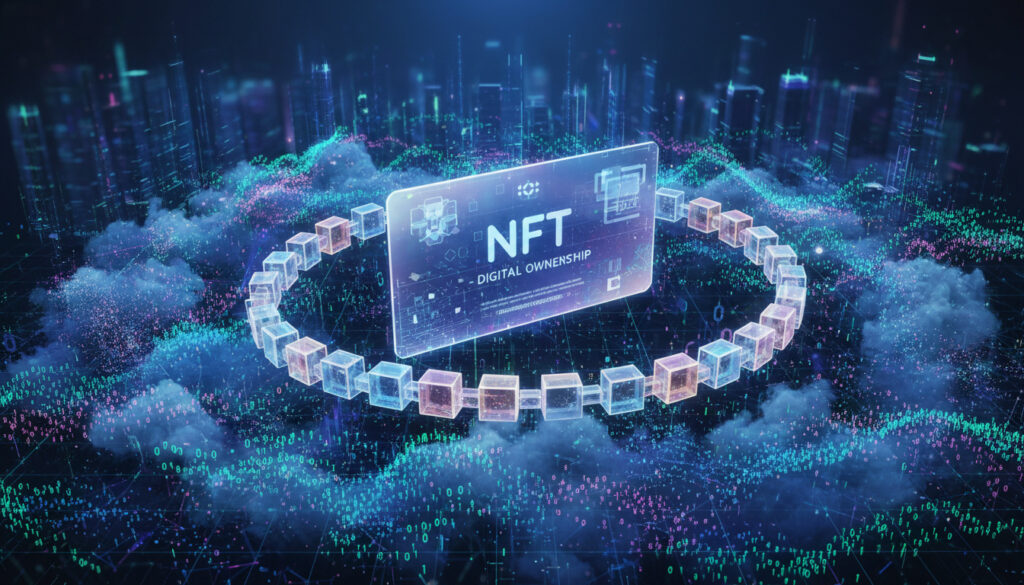
What Does NFT Stand For – Meaning, How It Works and History
NFT stands for non-fungible token, a unique digital identifier recorded on a blockchain that certifies ownership and authenticity of specific items ranging from digital art to music and collectibles. Unlike cryptocurrencies such as Bitcoin, which are interchangeable, each NFT possesses distinct characteristics that make it irreplaceable.
The acronym has become shorthand for a technological innovation that emerged from the intersection of blockchain technology and digital scarcity. Since their mainstream emergence in 2017, NFTs have transformed how creators monetize digital work and how collectors verify ownership in virtual spaces.
Understanding what NFT stands for requires examining both the technical architecture—specifically the ERC-721 standard on Ethereum—and the economic concept of fungibility that distinguishes these assets from traditional digital files.
What Does NFT Stand For?
Non-Fungible Token
Blockchain (ERC-721 standard)
Digital ownership verification
Mature ecosystem post-2021 hype
- NFTs prove unique digital scarcity through blockchain verification
- Each token contains metadata linking to specific digital files
- Ownership transfers transparently via decentralized ledgers
- Not currencies themselves, but certificates for assets
- Standards like ERC-721 prevent duplication and ensure interoperability
- Smart contracts automate royalties and transfer conditions
- Value derives from provenance and creator authenticity
| Attribute | Specification |
|---|---|
| Acronym Meaning | Non-Fungible Token |
| Concept Origin | 2014 (Colored Coins on Bitcoin) |
| Standard Implementation | ERC-721 (Ethereum, 2017) |
| Key Characteristic | Non-interchangeable uniqueness |
| Storage Method | Digital wallets with blockchain addresses |
| Primary Use Cases | Art, gaming assets, music, collectibles |
| Market Peak | 2021 ($25 billion in sales) |
| Current Focus | Utility and gaming integration |
What Is an NFT?
An NFT functions as a cryptographic token representing ownership of a unique item. While the digital files themselves—whether JPEGs, MP3s, or 3D models—can be copied infinitely, the NFT certifies who owns the original through blockchain records.
The Meaning of Non-Fungible
“Non-fungible” describes assets that cannot be exchanged on a like-for-like basis. A dollar bill or Bitcoin token is fungible—one unit equals another. An NFT, like a specific painting or house, carries unique properties that prevent equivalent substitution. Each token includes distinct metadata including creator details, ownership history, and links to associated files.
Digital Ownership Fundamentals
Ownership of an NFT does not necessarily grant copyright to the underlying artwork, but rather possession of the token itself—a distinction often misunderstood. The blockchain entry verifies the wallet address holding the asset, creating a permanent, tamper-proof record of provenance.
Purchasing an NFT typically grants you the token and potential usage rights defined by the creator, but not automatic intellectual property rights. Legal enforcement of associated rights remains informal and varies by platform and smart contract terms.
How Do NFTs Work?
NFTs operate through blockchain infrastructure, primarily using smart contracts—self-executing code that defines ownership rules, transfer conditions, and royalty distributions without intermediaries.
The Minting Process
Minting transforms digital files into blockchain assets. Creators upload content to NFT platforms, triggering smart contracts that generate unique tokens encoded with metadata and secure links to the files. This process establishes the token’s identity on the blockchain permanently.
Blockchain Verification
Once minted, the NFT exists on a decentralized ledger—most commonly Ethereum—where every transaction updates transparently. Wallets supporting standards like ERC-721 store these tokens, allowing owners to view and transfer assets through marketplaces.
Smart contracts embedded in NFTs can automatically distribute royalties to creators each time the token sells on secondary markets. This self-executing feature eliminates the need for manual tracking or legal enforcement of payment terms.
Scarcity and Standards
Uniqueness is enforced through metadata parameters. Creators can limit editions—minting only 10 copies of a digital artwork—or create one-of-one pieces. The ERC-721 standard formalized these specifications, while newer standards like ERC-1155 enable semi-fungible tokens for gaming items.
NFT vs Cryptocurrency: Key Differences
While both NFTs and cryptocurrencies utilize blockchain technology, they serve fundamentally different economic purposes and possess distinct technical properties.
Interchangeability
Cryptocurrencies like Bitcoin and Ethereum function as fungible assets—each token holds identical value and can be substituted freely. NFTs resist substitution because each contains unique metadata distinguishing it from all others.
Divisibility and Function
Bitcoin and Ethereum are divisible into smaller units (satoshis or wei), enabling micro-transactions. NFTs exist as whole units only—they cannot be divided while retaining their unique properties. Cryptocurrencies function primarily as stores of value or mediums of exchange, while NFTs represent specific assets or rights.
Unlike cryptocurrencies designed for trading and payments, NFTs derive value from subjective factors including artistic merit, cultural significance, and utility within specific ecosystems. Over 95% of NFT collections held zero value by September 2023, highlighting the speculative nature of these assets compared to established cryptocurrencies.
How Did NFTs Evolve?
-
Colored Coins: Early Bitcoin experiments tagged transactions to represent unique assets, establishing conceptual foundations for NFT technology.
-
ERC-721 and CryptoKitties: Ethereum introduced the ERC-721 standard, while the CryptoKitties game demonstrated NFT potential by allowing users to breed and trade unique digital cats, temporarily congesting the Ethereum network.
-
Mainstream Explosion: Artist Beeple (Mike Winkelmann) sold “Everydays: The First 5000 Days” for $69 million at Christie’s, validating NFT art markets and attracting global media attention.
-
Market Correction: Trading volumes declined sharply as speculative hype faded, shifting focus toward utility applications in gaming and membership credentials rather than pure investment vehicles.
What We Know vs. What Remains Uncertain
- NFT definitively stands for Non-Fungible Token
- ERC-721 is the foundational technical standard
- Ownership records are immutable on blockchain
- Each token contains unique metadata
- Smart contracts enable automated royalties
- Long-term legal recognition of NFT ownership rights
- Future regulatory frameworks across jurisdictions
- Sustainability of values for speculative collections
- Interoperability standards between blockchains
- Intellectual property enforcement mechanisms
NFTs Within Blockchain Ecosystems
NFTs occupy a specific niche within Web3 infrastructure, serving as the layer where digital scarcity meets creative expression. While cryptocurrencies handle value transfer, NFTs manage asset provenance and authenticity. This distinction matters for understanding why someone might purchase an NFT representing a digital artwork rather than simply downloading the image.
The technology has expanded beyond Ethereum to include blockchains like Solana, Tezos, and Layer-2 solutions addressing environmental concerns and transaction costs. What does habibi mean in this context? While unrelated to blockchain specifically, understanding cultural terminology helps navigate the global communities trading these digital assets.
Expert Definitions and Industry Perspectives
“NFTs are deeds to digital art, providing verifiable proof of ownership on chain.”
— Ethereum Foundation documentation
“Proof of ownership on chain distinguishes possession from mere access.”
— OpenSea documentation
Understanding the NFT Acronym
NFT stands for non-fungible token—a blockchain-based certificate of authenticity proving ownership of unique digital or physical assets. While the 2021 speculative bubble has passed, the underlying technology continues enabling new models for creator compensation, gaming economies, and digital identity. Understanding this acronym requires recognizing the difference between owning a token and controlling intellectual property, between blockchain verification and legal enforcement. For those exploring digital asset management, resources like Flea tablets for dogs demonstrate how specialized markets adopt verification technologies, though in entirely different contexts.
Common Questions About NFTs
Can an NFT be copied?
The digital file associated with an NFT can be copied infinitely, but the token itself cannot. The blockchain record proves which wallet owns the authentic version.
What does minting an NFT mean?
Minting refers to the process of creating a new NFT by recording it on the blockchain for the first time, establishing its unique identity and ownership.
Are NFTs environmentally harmful?
Early NFTs on Ethereum consumed significant energy, but the blockchain’s transition to proof-of-stake in 2022 reduced energy usage by approximately 99.95%.
Can you buy a fraction of an NFT?
Standard NFTs are indivisible, but fractional ownership platforms allow multiple investors to own shares of high-value NFTs through separate legal mechanisms.
Do NFTs store the actual image file?
Typically no. The NFT stores metadata and a link to the file hosted elsewhere (IPFS or centralized servers). The blockchain entry verifies ownership of the reference, not the file itself.
Why would someone buy an NFT?
Motivations include supporting artists directly, collecting digital art, accessing exclusive communities, gaming utility, and speculative investment based on perceived scarcity.
More related posts
 B&Q Voucher – Latest Verified Codes and Club Discounts
 Maggie Steed: Biography, TV Roles, and Career Highlights
 Georgina Rodríguez: Children, Age, and Relationship with Ronaldo
 Michael Flatley Now: Health, Net Worth, and Life in 2024
 Marina Hyde: Guardian Columnist, Podcast Host, and Satirist
 John Major: Downfall, Affair, Resignation, and Full Biography
 I Am Legend 2: Status, Cast, Release Date, and FAQs
 Tolu Arokodare: Profile, Salary, Transfer Fee & Stats
