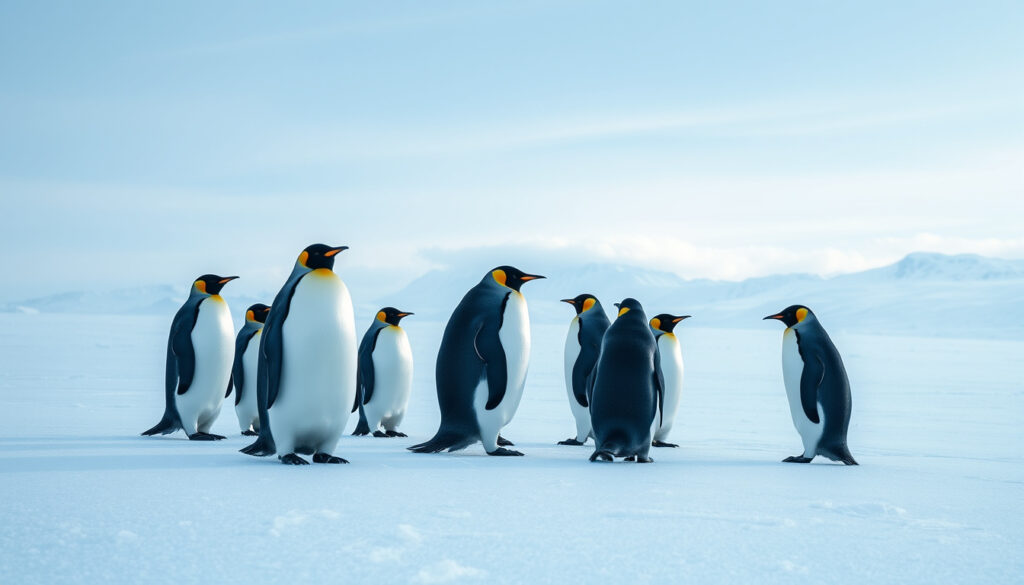
Emperor Penguins: Facts, Endangered Status & More
When you picture a penguin, the emperor probably comes to mind first — the tall, regal bird standing alone on Antarctic ice. These penguins are not only the largest of their kind, they also endure the planet’s harshest winter to raise their chicks.
Average Height: 100–122 cm (39–48 in) ·
Average Weight: 22–45 kg (49–99 lb) ·
Lifespan in the Wild: 15–20 years ·
Estimated Population: ~500,000 individuals (200,000 breeding pairs) ·
Maximum Dive Depth: 550 m (1,800 ft)
Quick snapshot
- Emperor penguins breed exclusively on Antarctic sea ice (Antarctic and Southern Ocean Coalition).
- They are the tallest and heaviest of all penguin species (Antarctic and Southern Ocean Coalition).
- They can dive to depths exceeding 500 metres (Antarctic and Southern Ocean Coalition).
- The species is now classified as Endangered (U.S. Fish and Wildlife Service).
- Exact rate of future sea ice loss in key breeding regions.
- How well emperor penguins can adapt by shifting colony locations.
- The precise impact of krill fishery competition on food availability.
- 1844 – First scientific description by George Robert Gray.
- 2023 – Emperor penguin reclassified as Endangered.
- 2024 – Studies show 98% of colonies could face quasi-extinction by 2100.
- Ongoing monitoring of sea ice extent and colony survival.
- Policy decisions on greenhouse gas reductions that directly affect Antarctic ice.
- Potential for new protected areas under the Antarctic Treaty.
| Attribute | Value |
|---|---|
| Scientific Name | Aptenodytes forsteri |
| Mass | 22–45 kg (49–99 lb) |
| Height | 100–122 cm (39–48 in) |
| Lifespan | 15–20 years in the wild |
| Conservation Status | Endangered (IUCN Red List) |
| Population Estimate | ~500,000 individuals |
| Distinctive Feature | Yellow-orange ear patches |
The pattern: this table distills the emperor penguin’s biology into a quick reference — a species defined by extremes in size, habitat, and vulnerability.
What are 5 fun facts about emperor penguins?
Unique breeding cycle
- Emperor penguins breed during the Antarctic winter, enduring temperatures as low as -60°C (Antarctic and Southern Ocean Coalition).
- Males incubate eggs on their feet for about 65 days while females travel up to 100 km to feed and return (British Antarctic Survey).
Extreme diving abilities
- They are the deepest-diving bird on the planet (Antarctic and Southern Ocean Coalition).
- Dives can last up to 20 minutes to capture prey such as Antarctic silverfish, krill, and squid (WWF UK).
Social huddling behaviour
- To conserve heat, hundreds of penguins huddle together, rotating positions so each bird spends time at the warm centre (National Geographic).
Feather adaptations for cold
- Emperor penguins have the highest feather density of any bird — up to 100 feathers per square centimetre — providing exceptional insulation (Antarctic and Southern Ocean Coalition).
Parental roles
- After the female returns, both parents take turns foraging and guarding the chick, a cooperative effort that lasts several months (British Antarctic Survey).
Bottom line: Emperor penguins are the only animals that breed during the Antarctic winter. For conservationists, protecting sea ice is non‑negotiable. For policymakers, every tenth of a degree of warming pushes more colonies toward failure.
Why is it called an emperor penguin?
Scientific name origin
- The scientific name Aptenodytes forsteri was given by George Robert Gray in 1844 (Biodiversity Heritage Library).
- The species was named in honour of Johann Reinhold Forster, a naturalist who accompanied Captain Cook (Encyclopædia Britannica).
Historical naming by explorers
- Early Antarctic explorers called it the “emperor” because of its size — it stands almost 1.2 m tall, towering over other penguins (National Geographic).
- Three explorers from Robert Falcon Scott’s expedition collected the first emperor penguin eggs in 1911 (British Antarctic Survey).
The implication: the name itself reflects both scientific homage and the sheer scale of a bird that dominates its landscape.
Which penguin is bigger, emperor or king?
Few comparisons in the penguin world are as common as emperor vs king. While both are large, the emperor is significantly bigger in every dimension.
| Trait | Emperor Penguin | King Penguin |
|---|---|---|
| Height | 100–122 cm | 70–100 cm |
| Weight | 22–45 kg | 11–16 kg |
| Ear/chest colour | Yellow-orange patch behind the ear | Bright orange on the upper chest |
| Geographic range | Exclusively Antarctica | Sub-Antarctic islands |
| Breeding cycle | Winter (Antarctic) | Spring/summer (sub‑Antarctic) |
The pattern: emperor penguins are about 1.5 times heavier and occupy a more extreme environment. For anyone trying to tell them apart, the colour of the patch on the neck is the quickest clue.
Why are emperor penguins now endangered?
Climate change and sea ice loss
- Emperor penguins depend on stable sea ice for breeding, feeding, and chick‑rearing (Antarctic and Southern Ocean Coalition).
- A 2024 analysis of satellite images from 2009 to 2024 found an average 22% decline in numbers across 16 colonies studied (University of Wollongong).
- Lead author Peter Fretwell described the observed rate of loss as about 50% worse than the most pessimistic earlier estimates (University of Wollongong).
Endangered species act listing
- The U.S. Fish and Wildlife Service reclassified the emperor penguin as Endangered in 2023 (U.S. Fish and Wildlife Service).
- A six‑year assessment published in Antarctic Science reported an increasing trend of colonies affected by early ice loss from 2018 through 2022 (Antarctic Science (Cambridge University Press)).
- In 2022, 19 of 66 colonies (29%) were impacted; 2023 was the second worst year with 14 colonies affected (Antarctic Science (Cambridge University Press)).
Population projections
- At current warming rates, 98% of colonies could be quasi‑extinct by 2100 (University of Wollongong).
Emperor penguins are trapped by their own biology: they cannot raise chicks without stable ice, and the ice is vanishing faster than they can adapt. For conservation planners, the window to act is closing at roughly 1.6% per year.
What do emperor penguins eat?
Main prey species
- Their diet consists mainly of Antarctic silverfish, krill, and squid (WWF UK).
- They hunt in open water or cracks in the ice (Antarctic and Southern Ocean Coalition).
Hunting techniques
- Dives last up to 20 minutes, reaching depths of 550 metres (Antarctic and Southern Ocean Coalition).
- They can hold their breath for over 20 minutes and use their wings to “fly” underwater (National Geographic).
Feeding frequency
- During chick‑rearing, adults make repeated foraging trips, often travelling 50–100 km to find prey (British Antarctic Survey).
As sea ice retreats, the distances to feeding grounds increase. For emperor penguins, that means longer journeys for less food — a direct energy cost that reduces chick survival.
Timeline: Emperor penguins in science and policy
A century of discovery and two decades of accelerating crisis.
| Year | Event |
|---|---|
| 1844 | First scientific description by George Robert Gray (Biodiversity Heritage Library). |
| 1911 | Three explorers from Robert Falcon Scott’s expedition collect first emperor penguin eggs (British Antarctic Survey). |
| 2012 | Satellite imagery reveals new colonies (British Antarctic Survey). |
| 2021 | USFWS proposes listing emperor penguin as threatened under the Endangered Species Act (U.S. Fish and Wildlife Service). |
| 2023 | Emperor penguin reclassified as Endangered; listing becomes effective (U.S. Fish and Wildlife Service). |
| 2024 | Studies show 98% of colonies could face quasi-extinction by 2100 under current warming (University of Wollongong). |
The pattern: each row marks a step from scientific curiosity to policy urgency.
What we know and what remains unclear
Confirmed facts
- Emperor penguins breed exclusively on Antarctic sea ice.
- They are the tallest and heaviest of all penguin species.
- They can dive to depths exceeding 500 metres.
- The species is now classified as Endangered.
What’s unclear
- Exact rate of future sea ice loss in key breeding regions.
- How well emperor penguins can adapt by shifting colony locations.
- The precise impact of krill fishery competition on food availability.
Voices from the field
This is a wake-up call that climate change is directly threatening a species.
— WWF Conservation Scientist
They are the only animals that breed during the Antarctic winter, enduring temperatures of -60°C.
— National Geographic Explorer
These perspectives underline the double bind emperor penguins face: they are exquisitely adapted to extreme cold, yet that very adaptation makes them helpless when the ice disappears.
The fate of the emperor penguin is now a mirror for our own decisions about carbon emissions. For the Antarctic ecosystem, the choice is stark: preserve enough winter ice to sustain 500,000 birds, or accept that the largest penguin on Earth becomes a casualty of the Anthropocene. For policymakers in Washington, London, and Canberra, the implication is clear: protect the ice by cutting emissions, or prepare for the quiet extinction of a species that has survived for millions of years.
To fully appreciate the emperor penguin’s life cycle, it helps to explore penguin habitats across the Southern Hemisphere across the Southern Hemisphere.
Frequently asked questions
How many emperor penguins are left?
~500,000 individuals (around 200,000 breeding pairs) according to the IUCN Red List.
What is the biggest threat to emperor penguins?
Climate‑driven sea ice loss. Without stable ice, breeding colonies collapse.
Do emperor penguins live in the Arctic?
No. They are found exclusively in Antarctica.
How do emperor penguins survive the extreme cold?
Dense feathers, a thick layer of blubber, and social huddling — they pack together tightly to conserve heat.
Are emperor penguins monogamous?
They are serially monogamous: they usually mate with the same partner each season but may switch the following year.
How fast can emperor penguins swim?
They can reach speeds of 15–20 km/h (9–12 mph) underwater.
What is the difference between emperor and king penguin eggs?
Emperor penguin eggs are slightly larger and are incubated on the feet; king penguin eggs are also incubated on the feet but in a milder sub‑Antarctic climate.
Can emperor penguins fly?
No. Like all penguins, they are flightless birds. Their wings have evolved into flippers for swimming.
More related posts
 Bernard Bresslaw: Carry On Actor and Gentle Giant
 Loft Bed Guide: Adult Suitability, Cost, and Building Tips
 Stig of the Dump: Plot, Reading Age, True Story & TV Adaptations
 Mimi Xu: Biography, Age, Height, Ranking & Career Highlights
 How Many Gram in a Tea poon? Complete Conver ion Guide
 Imran Khan: From Cricket Star to Imprisoned PM
 Alesha Dixon: Ethnicity, Career, Husband Split, Net Worth
 Mary Tyler Moore: Cause of Death, Net Worth, and Personal Life
